
- What Makes Celine Packaging Recognizable?
- Celine Dust Bag: Why Textile Packaging Matters
- Celine Packaging Real vs Fake Bag: What Packaging Can—and Cannot—Tell You
- What Global Brands Can Learn from Celine Packaging
- From Reference Image to Manufacturable Packaging
- Quality Control for Premium Fabric Packaging
- Sustainable Packaging: Reuse Is Becoming More Important
- Biben’s Approach to Custom Fabric Packaging
- What Procurement Managers Should Send for a Quotation
- Frequently Asked Questions About Celine Packaging and Custom Bags
- Conclusion: Turn Luxury Packaging Principles into Your Own System
Luxury packaging is easy to admire and surprisingly difficult to execute well.
For overseas retailers, fashion brands, beauty companies and promotional buyers, the challenge is rarely as simple as choosing an attractive bag and printing a logo on it. Material weight, fabric texture, stitching, drawstring construction, logo placement, color consistency, packing efficiency and intended reuse all affect how the finished packaging is perceived. A design that looks premium on a screen can feel inexpensive when produced with the wrong fabric or poorly controlled printing.
Celine packaging provides a useful case study because its visual language demonstrates how restrained design can communicate premium positioning. Rather than depending on excessive decoration, the packaging system associated with the brand uses controlled typography, neutral colors, tactile materials and relatively simple structures. Reference analyses of the brand’s packaging commonly identify rigid boxes, paper shopping bags and textile dust bags as important parts of this system.
For other brands, however, the objective should not be to reproduce Celine packaging or trademarks. The more valuable lesson is understanding why a minimalist packaging system works and then translating those principles into an original packaging identity.
This is particularly relevant as packaging decisions become connected to environmental policy as well as aesthetics. The EU’s new packaging rules emphasize waste reduction, recyclability and reuse, while the UK’s extended producer responsibility system creates incentives to reduce unnecessary packaging and improve recyclability. Australia and Canada are also pursuing policies intended to reduce problematic single-use packaging.
For companies developing reusable textile packaging, Biben applies more than 10 years of bag manufacturing experience to cotton, canvas, RPET polyester, Tyvek, washable kraft paper and other customized structures. Buyers can explore Biben’s custom eco bags wholesale solutions when comparing materials and structures for their own branded packaging.
This guide examines Celine packaging from a packaging-development perspective, with particular attention to dust bags, cotton packaging, polyester alternatives, manufacturing decisions, sustainability and global B2B sourcing.
What Makes Celine Packaging Recognizable?
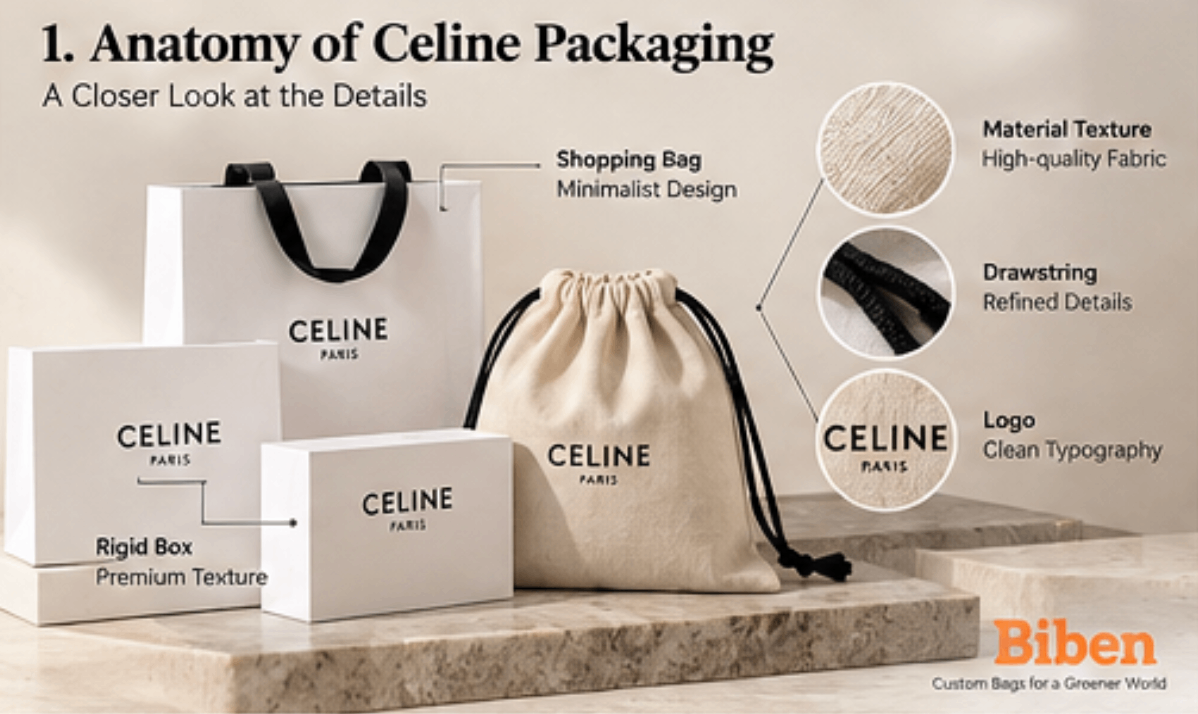
Luxury packaging is usually a system rather than a single object. The product box, shopping carrier, protective pouch, tissue, labels and transport packaging all contribute to the customer experience.
Reference analysis of Celine’s packaging highlights a restrained visual system built around white or neutral surfaces, black branding, structured paper components and soft textile packaging. One detailed packaging analysis describes white rigid boxes, heavyweight shopping bags and natural-tone cotton canvas dust bags as representative components of the brand’s minimalist packaging language.
The important point for packaging buyers is not the exact color or logo. It is consistency.
A minimalist system leaves fewer places for production errors to hide. When a design contains one small logo on a plain surface, an inaccurate print position becomes obvious. When a cotton dust bag uses a natural uncoated texture, inconsistent fabric coloration is easier to notice. When decoration is limited, stitching quality, material hand-feel and proportion become more important.
This is one reason “simple” luxury packaging can require considerable manufacturing control.
Celine Bag Packaging and the Idea of Quiet Luxury
Quiet luxury in packaging is not synonymous with blank packaging. Successful minimalist packaging depends on hierarchy.
The material establishes the first sensory impression. Structure establishes function. Color creates visual consistency. Typography identifies the brand. Finishing adds emphasis only where necessary.
In the Celine packaging reference examined for this article, rigid boxes are described as using textured white surfaces with restrained black branding. Shopping bags follow a similarly controlled palette, while textile dust bags extend the system through softer natural materials.
For a developing fashion or beauty brand, the lesson is highly transferable. Instead of adding more decorative features to make packaging appear expensive, procurement teams can ask whether each feature has a purpose.
A strong original system might use an undyed cotton pouch, a one-color screen-printed logo, a carefully selected cord and a consistent woven label. Another brand might choose RPET polyester, a custom Pantone color and a compact foldable structure. Neither needs to resemble Celine visually to apply the same principle of disciplined design.
Celine Dust Bag: Why Textile Packaging Matters
A dust bag has a practical purpose: it creates a soft protective layer around a handbag, footwear, accessory or other product during storage.
But in premium retail, it also becomes part of the perceived product.
A disposable wrapper is normally discarded. A well-made fabric dust bag can remain with the purchased item for years, meaning the customer repeatedly encounters the brand through the packaging.
Reference material describing a Celine dust bag points to a natural cotton-canvas appearance, neutral coloring, drawstring construction and understated branding. Another supplier reference associated with Celine-style luxury-brand packaging lists polyester as the material for one dust-bag example. These references demonstrate something important for procurement managers: there is no reason to assume every textile packaging item associated with a luxury category uses exactly the same fiber, construction or specification. citeturn2view0turn2view1
Material identification should therefore be based on the actual sample and technical specification being sourced—not an image alone.
Celine Cotton Bag Packaging: What Cotton Contributes
Cotton is especially suitable when the packaging concept requires a natural tactile character.
Unlike a highly polished synthetic surface, natural cotton can display subtle fiber texture. That visual irregularity can become part of the premium impression when the fabric, sewing and printing are properly controlled.
For fashion packaging, cotton drawstring bags can be adapted for handbags, shoes, apparel, accessories and gift products. The same material family can also be developed into shopping totes or promotional bags, helping a brand maintain visual continuity across several packaging formats.
From a manufacturing perspective, however, “cotton bag” is not a complete specification.
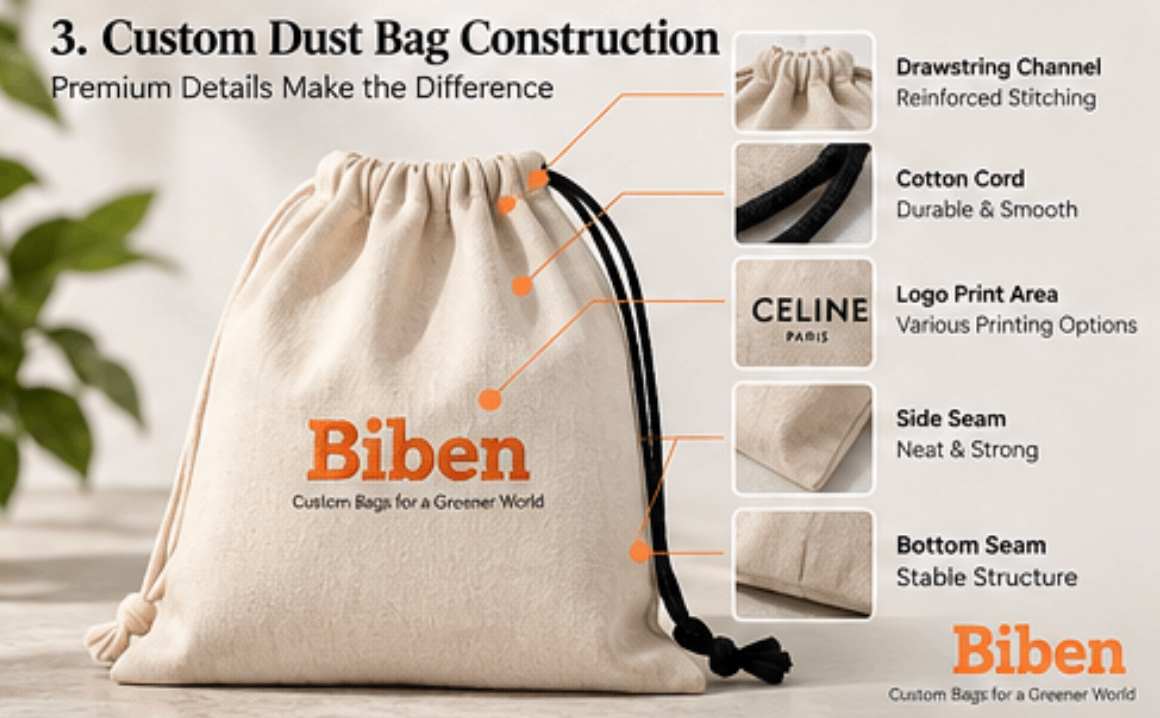
The buyer must still determine the required fabric construction, thickness, dimensions, closure, seam treatment, print area, color, handle or cord material and packing method. An approved reference sample is particularly useful because descriptions such as “premium,” “soft” or “heavy” can be interpreted differently by different buyers and factories.
Biben’s production approach begins with these functional requirements rather than treating the material name as the finished specification.
Celine Polyester Bag References: When Polyester Makes Sense
Searches for “Celine polyester bag” or similar terms reveal another important sourcing question: when should a brand use polyester rather than cotton?
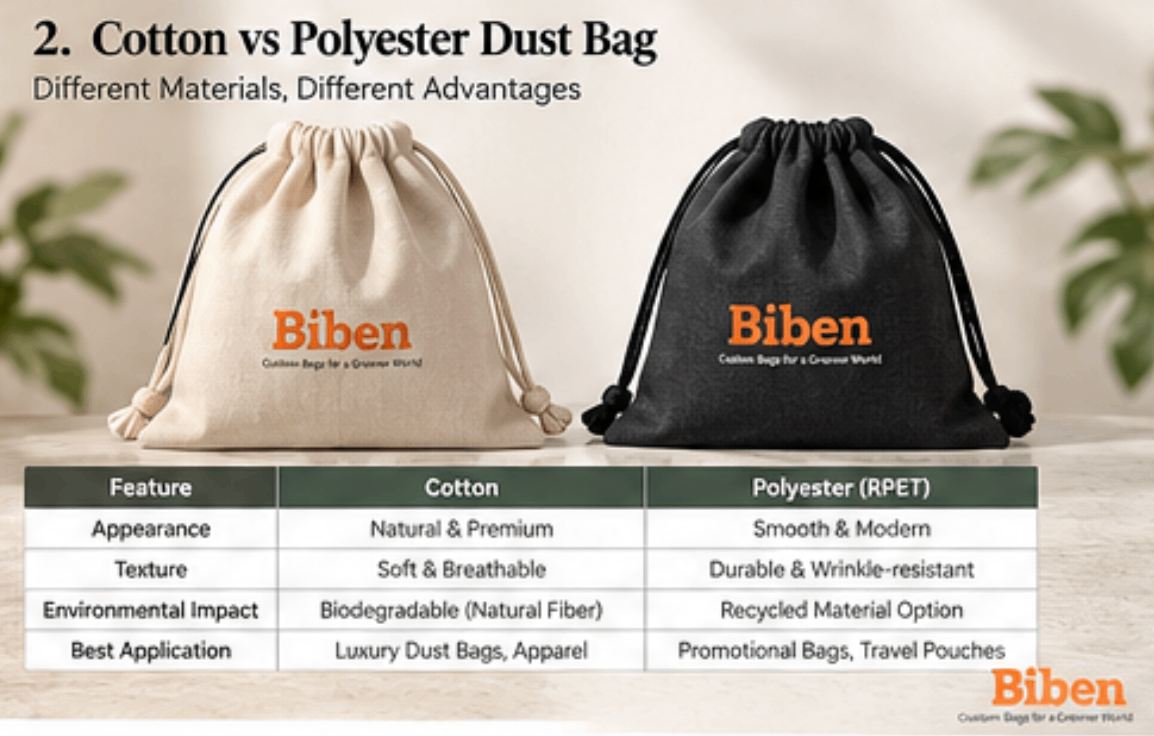
Polyester can be useful when low weight, dimensional consistency, compact storage or certain print requirements matter more than a natural-fiber hand-feel. RPET recycled polyester can also be considered when a project specifically calls for recycled synthetic content, subject to the documentation and claims required by the buyer.
Cotton and polyester should therefore not be treated as “premium versus cheap.” They solve different packaging problems.
| Material | Typical Character | Useful Packaging Applications | Procurement Considerations |
|---|---|---|---|
| Natural cotton | Soft, tactile, natural appearance | Dust bags, totes, apparel packaging | Fabric texture, shrinkage, color variation and print behavior |
| Canvas | More structured textile feel | Premium totes, heavier pouches | Weight, seam construction and shipping volume |
| RPET polyester | Lightweight, versatile, recycled-content option | Foldable bags, promotional bags, pouches | Recycled-content documentation and printing compatibility |
| Tyvek | Lightweight, distinctive paper-like appearance | Fashion totes, zipper pouches, special packaging | Structure, print method and intended reuse |
| Washable kraft paper | Textured paper-like visual character | Lifestyle and retail bags | Folding behavior, sewing and finishing |
| PVC composite | Transparent or semi-transparent presentation | Cosmetic and promotional pouches | Market requirements and end-of-life considerations |
The correct material is the one that meets the product’s functional, branding, regulatory and commercial requirements simultaneously.
Celine Packaging Real vs Fake Bag: What Packaging Can—and Cannot—Tell You
“Celine packaging real vs fake bag” is a common search phrase, but packaging should never be treated as a standalone authentication method.
Packaging changes across seasons, product categories, markets and retail channels. Genuine packaging can also be separated from the original product, while counterfeit goods may imitate boxes, dust bags and shopping carriers.
Older authentication references have compared features such as typography, heat stamping, stitching and internal tags on specific Celine handbag examples. Those observations may be useful for understanding how closely premium manufacturing details are examined, but they should not be converted into a universal authentication checklist.
For consumers assessing an expensive luxury item, provenance, purchase documentation and evaluation by a qualified authentication service are more meaningful than relying on a dust bag or shopping bag.
For B2B packaging buyers, there is a different lesson.
Small details matter.
A poorly aligned logo, uneven seam, inconsistent cord length or uncontrolled color difference can weaken the perceived quality of an otherwise good product. This is why packaging development requires an approved specification rather than simply asking a factory to “make it luxury.”
Brand Inspiration Is Different from Brand Replication
Companies can study established luxury packaging for material, structural and customer-experience lessons. They should not reproduce another company’s trademarked logo, protected graphics or packaging in a way that suggests an unauthorized commercial relationship.
The better development brief is therefore not “copy this Celine bag.”
It is something like: “We want an understated reusable cotton dust bag for a premium leather-goods brand, using our own logo, colors, dimensions and closure design.”
That change in thinking leads to a more defensible brand identity and usually a better long-term packaging system.
What Global Brands Can Learn from Celine Packaging
The strongest lesson from Celine packaging is restraint, but restraint only works when execution is controlled.
A plain cotton pouch with poor stitching does not become luxurious because it is minimal. A one-color logo is not automatically sophisticated if the ink coverage varies across the order. A reusable bag is not automatically sustainable simply because the word “eco” appears in its marketing.
Procurement teams should convert aesthetic concepts into measurable production requirements.
Material Should Support the Brand Position
A beauty company may prioritize clean surfaces, zipper security and resistance to handling. A fashion retailer may prefer cotton or canvas because textile texture complements apparel. An event company may prioritize low unit weight, high logo visibility and cost efficiency. A food business may require insulated construction instead of a conventional tote.
Biben’s product scope reflects these different applications: reusable shopping bags, promotional event bags, cosmetic zipper bags, apparel totes, insulated cooler and food bags, and special structures such as mesh or foldable bags.
The material should follow the use case rather than the other way around.
Logo Technique Changes the Result
Printing is one of the areas where buyers frequently underestimate manufacturing differences.
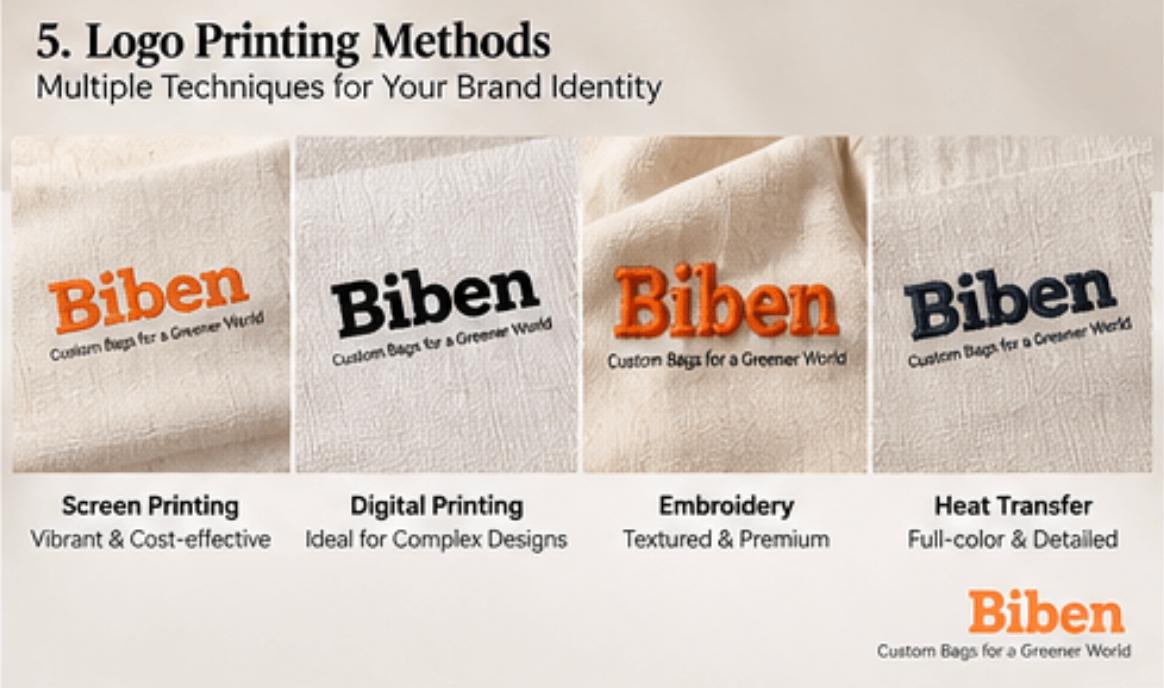
Screen printing is well suited to many relatively simple logos and solid-color graphics. Digital printing can be more appropriate for complex multicolor artwork. Heat-transfer processes can support particular full-color applications, while embroidery introduces a dimensional textile effect. Embossed treatments can create a more subtle tonal identity on compatible materials.
Biben’s manufacturing capabilities include multiple logo-finishing methods, with the appropriate process selected according to material, artwork and desired appearance.
The artwork should therefore be evaluated together with the fabric. A printing method that works well on one material may not create the same result on another.
Color Matching Requires Physical Approval
Digital screens are unreliable references for exact textile color.
Displays vary, lighting changes perception, and different substrates can make nominally similar colors appear different. A logo printed on natural cotton will not necessarily look identical to the same color printed on a coated synthetic material.
For color-sensitive brand projects, physical sampling is therefore an important control stage.
A useful pre-production sample allows the buyer to inspect proportion, material feel, stitching, logo placement, closure behavior and overall appearance before mass production begins.
From Reference Image to Manufacturable Packaging
A frequent sourcing scenario begins with a buyer sending several photographs and saying, “We want something like this.”
Photographs are useful, but they are not manufacturing specifications.
A factory still needs to convert the concept into material choices, dimensions, construction details and artwork instructions. That translation stage often determines whether the final order meets expectations.
Step 1: Define the Packaging Function
Start with the product being packed.
A handbag dust bag has different requirements from a foldable promotional carrier. A cosmetic zipper pouch needs a different closure system from an apparel tote. A cooler bag requires an insulated structure that a conventional cotton bag does not provide.
The product dimensions also affect bag proportions and material consumption.
A buyer should therefore provide the intended contents, approximate product dimensions, desired bag dimensions, order quantity and target use before focusing on decoration.
Step 2: Select Material by Performance and Brand Identity
For a Celine cotton bag packaging-inspired project—meaning a project inspired by the broader concept of restrained textile luxury rather than a replica—natural cotton or canvas may be logical starting points.
But they are not the only choices.
RPET polyester can suit lightweight reusable applications. Tyvek can create a distinctive contemporary surface. Washable kraft paper offers another tactile direction. PVC composite materials can be appropriate where visibility is a functional design requirement.
Biben works across these material categories so the buyer can compare options rather than forcing every project into a single fabric.
Step 3: Engineer the Structure
The next decisions include bag opening, gusset, seam construction, handles, drawstrings, zipper placement, pockets and other accessories.
At this stage, apparently minor changes can affect both usability and cost.
Adding a zipper changes sewing operations. Increasing bag depth changes fabric consumption. Adding internal pockets creates additional cutting and assembly work. A special cord or handle can change both appearance and sourcing complexity.
A professional quotation therefore depends on a sufficiently clear specification.
Step 4: Choose the Branding Process
Logo development should consider size, position, color count and production method.
For understated packaging, a smaller logo can create a premium result—but only when its position is controlled. For promotional packaging, a larger print area may be more commercially useful because visibility is the primary objective.
This distinction matters. Luxury retail packaging and event giveaway bags can come from the same manufacturing category while serving very different marketing goals.
Companies developing campaign bags can review Biben’s bulk promotional bag customization capabilities to compare materials, structures and printing options.
Step 5: Approve Artwork and Sample
Sampling is the bridge between specification and mass production.
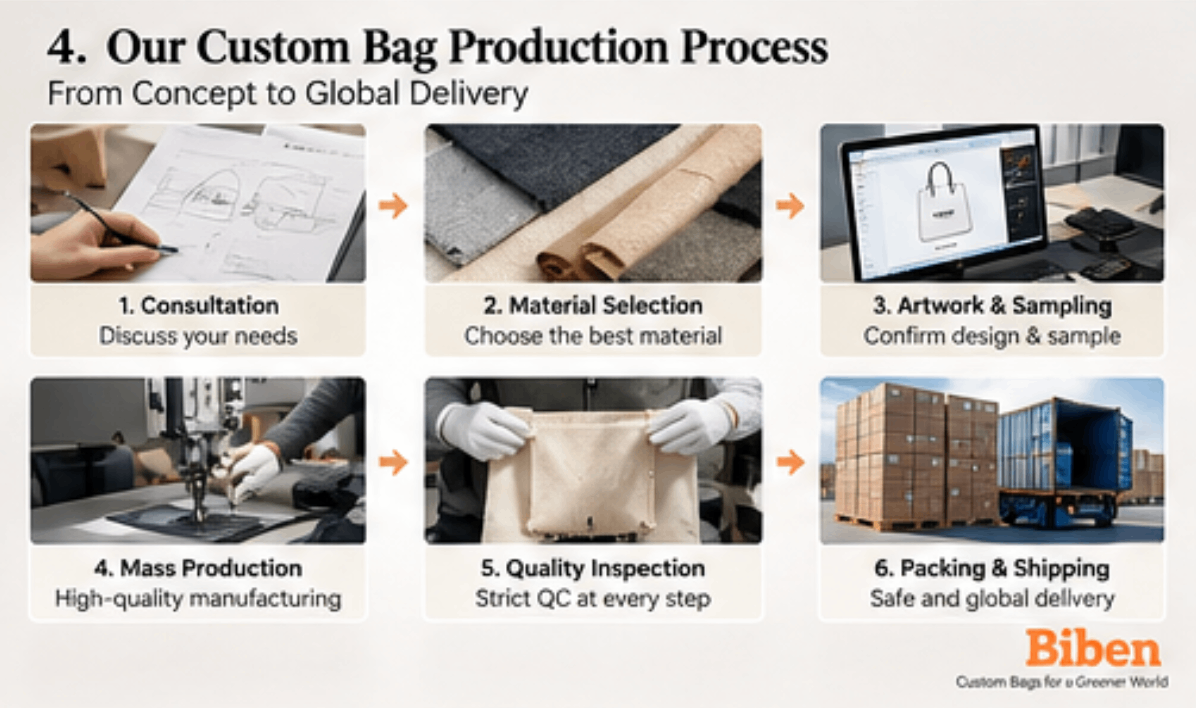
Biben’s published ordering workflow includes consultation, artwork and quotation, sample confirmation, mass production and delivery. Its broader custom-bag workflow also emphasizes pre-production sample approval before manufacturing.
During sample review, the buyer should evaluate the complete object rather than the logo alone.
Check the dimensions with the actual product. Open and close the bag. Examine seams and stress points. Look at the logo under normal lighting. Compare color with approved references. Confirm that cords, zippers and handles behave as intended.
Changes are far easier to resolve before mass production.
Quality Control for Premium Fabric Packaging
Quality inspection should begin before the finished bag exists.
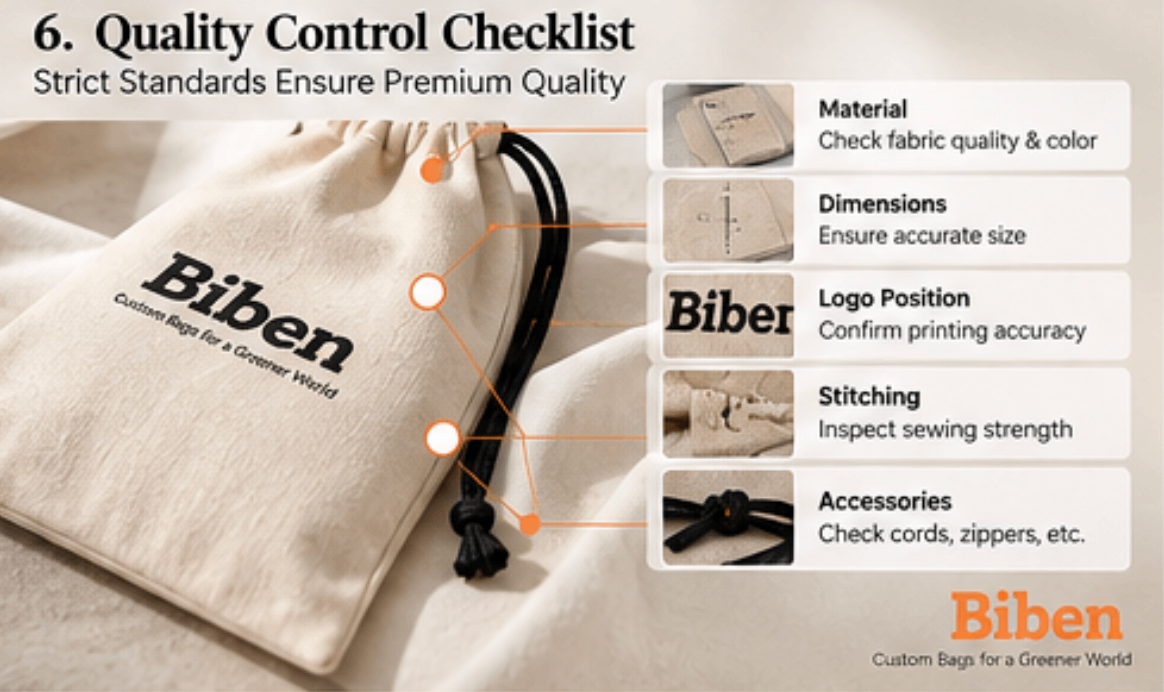
Biben describes quality management across raw material inspection, cutting, logo printing, sewing and final packing, with production photographs available for review before shipment.
That sequence matters because final inspection cannot efficiently correct every upstream problem.
If fabric color is incorrect, sewing it perfectly does not solve the problem. If the print position is wrong, final packing cannot fix it. If a zipper specification was misunderstood, detecting the issue only after the full order is completed creates unnecessary cost and delay.
What Should Be Checked?
For a typical custom textile packaging order, inspection should consider material appearance, dimensions, printing, stitching, construction, accessories and packing consistency.
The exact tolerance requirements should be agreed for the project rather than assumed.
For visually sensitive packaging, buyers should also identify which characteristics are critical to the brand. A luxury fashion company may consider logo alignment and fabric shade critical. An event company may care more about print visibility and quantity accuracy. A food-delivery operator may prioritize functional construction.
Quality control works best when “quality” has been translated into project-specific requirements.
Sustainable Packaging: Reuse Is Becoming More Important
Packaging sustainability has moved from a marketing discussion into regulatory and procurement strategy.
In the European Union, new packaging rules applying from August 2026 introduce requirements aimed at reducing packaging waste and improving reuse and recovery. The European Commission states that the rules cover manufacturing and composition requirements for packaging placed on the EU market and that certain single-use packaging formats will face restrictions from 2030.
In the United Kingdom, extended producer responsibility for packaging shifts more end-of-life waste-management costs toward producers placing packaging on the market. UK guidance explicitly identifies reducing unnecessary packaging, reuse where practical and improved recyclability as intended incentives.
Australia’s National Packaging Targets include an objective for packaging to be reusable, recyclable or compostable, while Canada’s Single-use Plastics Prohibition Regulations prohibit specified categories including single-use plastic checkout bags.
These frameworks differ substantially, so a reusable fabric bag should never be marketed as “globally compliant” merely because of its material.
Avoiding Vague Environmental Claims
“Eco-friendly” is not a technical specification.
Buyers should ask more precise questions. What material is being used? Is recycled content required? What evidence is available? Is the product designed for repeated use? Does the structure combine materials in ways that complicate end-of-life treatment? What environmental claims will appear on the finished packaging?
Cotton, RPET polyester, Tyvek and washable kraft paper each have different characteristics. The best choice depends on expected reuse, required performance, production method, logistics and the regulatory context of the destination market.
This is more credible than assuming one material is universally sustainable.
Biben’s Approach to Custom Fabric Packaging
Biben is a direct Chinese manufacturer specializing in customized shopping and promotional packaging bags, with more than 10 years of manufacturing experience.
Its product range includes cotton and canvas bags, reusable shopping carriers, promotional bags, zipper pouches, backpacks, drawstring sacks, insulated bags and other custom fabric packaging. Material options include natural cotton, RPET recycled polyester, Tyvek, washable kraft paper, canvas and PVC composite materials.
The central advantage for B2B buyers is not a single standard product. It is the ability to customize structure, material, logo process and color around the project.
Biben supports relatively flexible custom-order thresholds, generally starting around 500–1,000 pieces per design depending on the product and specification. That makes custom development more accessible to growing brands and smaller campaign orders while remaining suitable for larger wholesale projects.
Working Directly with a Manufacturer
Direct factory communication can reduce the number of handoffs between the buyer’s design concept and the production team.
It also makes technical conversations more useful.
Instead of requesting a generic “luxury pouch,” the buyer can discuss fabric options, print processes, bag dimensions, closures and expected quantity as connected variables. Once the specification is defined, artwork and sampling provide opportunities to verify the design before production.
Biben’s published process follows this logic: project consultation, artwork and quotation, pre-production sample confirmation, mass production, inspection, packing and shipment.
For brands exploring less conventional lightweight retail structures, Biben’s custom Tyvek bag and material options can also provide an alternative to conventional cotton or polyester packaging.
What Procurement Managers Should Send for a Quotation
The quality of a quotation depends heavily on the quality of the brief.
A buyer does not need to solve every manufacturing detail before contacting the factory, but several pieces of information make initial evaluation much faster:
- Intended bag type and application
- Approximate dimensions
- Preferred material or reference material
- Estimated order quantity
- Logo artwork and number of colors
- Desired printing or finishing effect
- Required accessories or closures
- Destination market
- Reference photographs where useful
- Target delivery requirements
When the material is undecided, explain the desired effect instead. “Natural textured dust bag for premium footwear” is more useful than simply writing “luxury bag.”
The factory can then recommend material and construction options consistent with the brief.
Frequently Asked Questions About Celine Packaging and Custom Bags
1. What is Celine packaging known for?
Celine packaging is widely associated with a restrained luxury aesthetic using controlled typography, neutral colors and coordinated paper and textile components. The useful lesson for other brands is consistency rather than imitation: develop an original system in which materials, colors, structures and branding work together. Biben can help translate that direction into a custom specification for your own brand.
2. What material is a Celine dust bag made from?
Reference analyses describe natural cotton or cotton-canvas dust bags in Celine packaging, while other supplier references associated with the category show polyester examples. Packaging can vary by product and period, so an actual sample should be inspected before making a material claim. For a custom project, Biben can compare cotton, canvas and polyester options according to the required feel and function.
3. Is cotton better than polyester for luxury packaging?
Not universally. Cotton provides a natural tactile appearance, while polyester can offer lightweight construction and different printing or functional possibilities. RPET polyester can also support projects specifying recycled synthetic content. Biben can recommend a material after reviewing the product, intended reuse, design and budget.
4. Can packaging tell whether a Celine bag is real or fake?
Packaging alone is not reliable proof of authenticity. Packaging changes and can be separated from the original product, while counterfeit packaging can imitate genuine visual features. Buyers of luxury goods should use reliable provenance and qualified authentication rather than a dust bag alone. For original branded packaging projects, Biben can help develop proprietary details instead of copying Celine trademarks.
5. Can Biben manufacture Celine-branded dust bags?
Biben’s business is custom manufacturing for clients’ own legitimate brands and packaging projects. Studying luxury packaging can provide useful design lessons, but another company’s trademarks or protected branding should not be reproduced without authorization. Biben can instead develop an original cotton, polyester or other textile packaging solution around your own identity.
6. What is Biben’s MOQ for custom packaging bags?
Biben’s general custom MOQ is approximately 500–1,000 pieces per design, depending on the bag, material and specification. More complex custom materials or processes can affect practical production quantities. Buyers can send the target quantity and design requirements to Biben for project-specific evaluation.
7. Can I request a sample before mass production?
Yes. Sampling is an important stage of custom packaging development because it allows buyers to review material, dimensions, construction, logo placement and overall appearance before mass production. Biben’s published workflow includes pre-production sample confirmation. Contact Biben with your artwork and requirements to discuss the appropriate sample process.
8. Which printing method is best for a minimalist logo?
The answer depends on artwork and material. Screen printing can work well for many simple solid-color graphics, while digital printing suits more complex artwork; embroidery, heat transfer and other finishes create different effects. Biben can recommend a process after reviewing the fabric and logo rather than selecting a method based on appearance alone.
9. Can Biben produce packaging for the US, UK, EU, Canada and Australia?
Biben serves international B2B projects and manufactures custom bags for overseas markets. However, environmental and packaging requirements vary by jurisdiction and product, so buyers should identify destination-specific compliance and claim requirements during development. Biben can help adapt the material and construction specification to the buyer’s project requirements.
10. What information should I send Biben for a custom quotation?
Provide the bag type, approximate size, material preference, quantity, logo artwork, printing requirements, accessories, destination and reference images where relevant. If some details are undecided, explain the intended application and desired appearance. Biben can then recommend suitable custom options and prepare a project-specific quotation.
Conclusion: Turn Luxury Packaging Principles into Your Own System
Celine packaging is valuable to study because it demonstrates a principle that applies far beyond one luxury label: packaging does not need excessive decoration to communicate value.
Materials, proportion, tactile quality, printing precision and consistency can carry much of the brand message.
The Celine dust bag is particularly relevant to companies considering reusable textile packaging. Cotton and canvas can create a natural premium character, while polyester and RPET polyester offer different functional possibilities. Tyvek, washable kraft paper and other materials expand the design vocabulary further.
But the goal for another brand should never be to reproduce Celine packaging.
The commercially stronger strategy is to identify what makes the reference effective—restraint, consistency, useful protection, material quality and controlled branding—and translate those principles into an original packaging system. A beauty brand, apparel retailer, hospitality company or promotional agency can all apply these lessons while developing completely different visual identities.
Sustainability adds another layer to the decision. With packaging policy evolving across the EU, UK, Canada, Australia and other markets, procurement teams increasingly need to consider reuse, material selection, waste reduction and the accuracy of environmental claims alongside price and appearance.
This is where manufacturing knowledge becomes important.
With more than 10 years of experience, Biben provides a one-stop customized bag service for global enterprises, covering material selection, structural customization, artwork and logo-process development, sampling, production, quality inspection and shipment. Custom projects can use natural cotton, canvas, RPET polyester, Tyvek, washable kraft paper, PVC composite materials and other options, with low MOQs generally ranging from 500–1,000 pieces depending on the design.
Whether you are developing a premium cotton dust bag, reusable retail tote, promotional carrier, cosmetic zipper pouch, apparel packaging bag or insulated food bag, the process should begin with your own product and brand—not someone else’s logo.
Send Biben your dimensions, target quantity, artwork, material preference and destination market to request a custom quotation or sample. Or browse Biben’s complete product range to start building a packaging system that customers recognize as unmistakably yours.

Author: Gary — Founder of Biben Packaging
With a decade of leadership in the custom packaging industry, Gary has built Biben Packaging into one of China's most trusted manufacturers of reusable and sustainable shopping bags. His deep expertise in materials, printing, structural design, and scalable production allows him to guide brands toward cost-effective and eco-friendly packaging solutions.